All familiar ingredients of the universe — visible matter, radiation, and even dark matter — share a common feature: as the universe expands, their density decreases. They spread out.
Dark energy seems to behave differently. It does not seem to dilute significantly as the universe expands, which makes it unlike any other component we know.
As a result, it comes to dominate the energy content of the universe today.
On large scales, dark energy appears to act as a smooth, homogeneous background. It does not clump, but instead influences the expansion of the universe as a whole.
Earlier, we described the expansion as a collection of objects set in motion away from each other, with gravity acting as a brake. Dark energy changes this picture. Rather than slowing the expansion, it counteracts gravity and causes the distances between objects to grow at an accelerating rate. As a consequence, it suppresses the growth of structure.
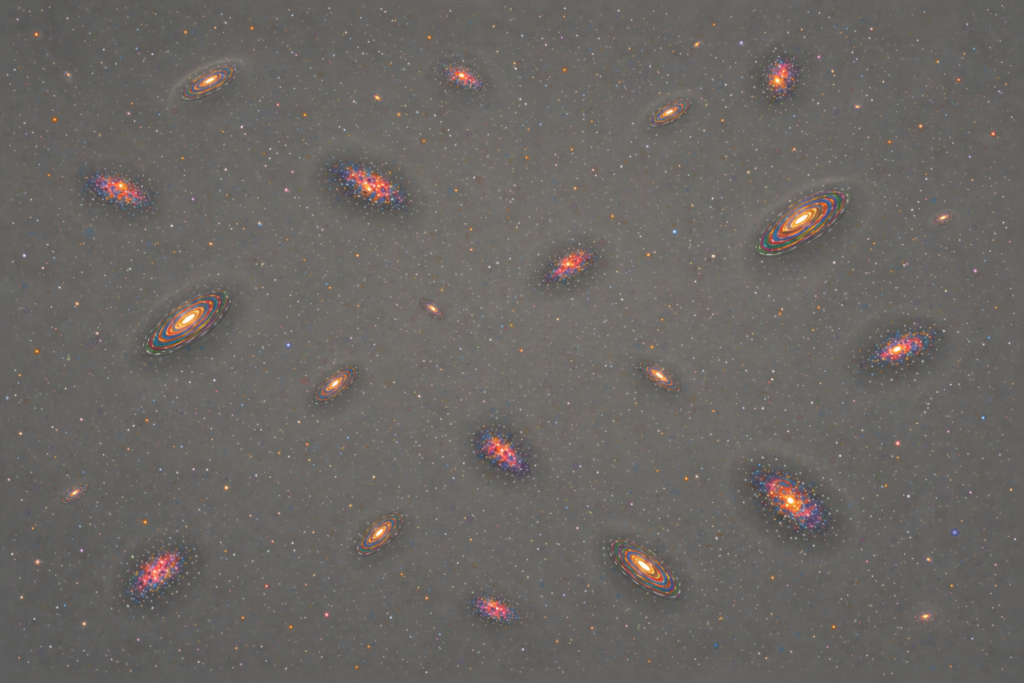
This effect applies to objects that follow the large-scale expansion. On smaller scales, its effects are much less significant. Galaxies, planetary systems, and atoms remain bound, their internal dynamics governed by their own interactions and largely unaffected by dark energy.
What we observe, therefore, is a universe in which two tendencies compete: gravity, which pulls objects together, and dark energy, which drives them apart.
What dark energy actually is remains unknown. It is not something we can see directly, but something we infer from the large-scale behavior of the universe. For now, it is simply a name for an observed effect — the tendency of the universe to expand at an accelerating rate.