We have discussed the visible content of the universe.
It is now time to address the elephant in the room.
There is strong evidence that the universe contains significantly more matter than what we can see through light — roughly five times as much.
This immediately raises a natural question:
How can we know something exists if we cannot see it?
After all, the usual way we observe objects is through light — either emitted or reflected.
However, there is another way.
Instead of looking for the object itself, we can observe how it influences the motion of objects we do see.
Consider a simple example.
Suppose we observe a rock in space moving in a circle, with nothing else visible nearby. The motion itself tells us that something must be causing it to change direction.
If we rule out artificial explanations, the most natural conclusion is that there is another object — unseen — pulling on it gravitationally.
This idea has been used successfully before.
In the 19th century, the motion of the planet Uranus could not be fully explained by the known planets. Urbain Le Verrier showed that the discrepancies could be resolved by postulating the existence of another planet.
Based on this reasoning, he was able to predict where it should be found. The planet Neptune was subsequently discovered almost exactly at the predicted location.
The evidence for dark matter is of the same nature.
We do not see it directly, but we observe its gravitational effects.
The first clear indication came from the motion of stars and gas in spiral galaxies. The observed motion requires much more matter than what is visible, and this additional matter must be distributed over a much larger region than the luminous galactic disk.
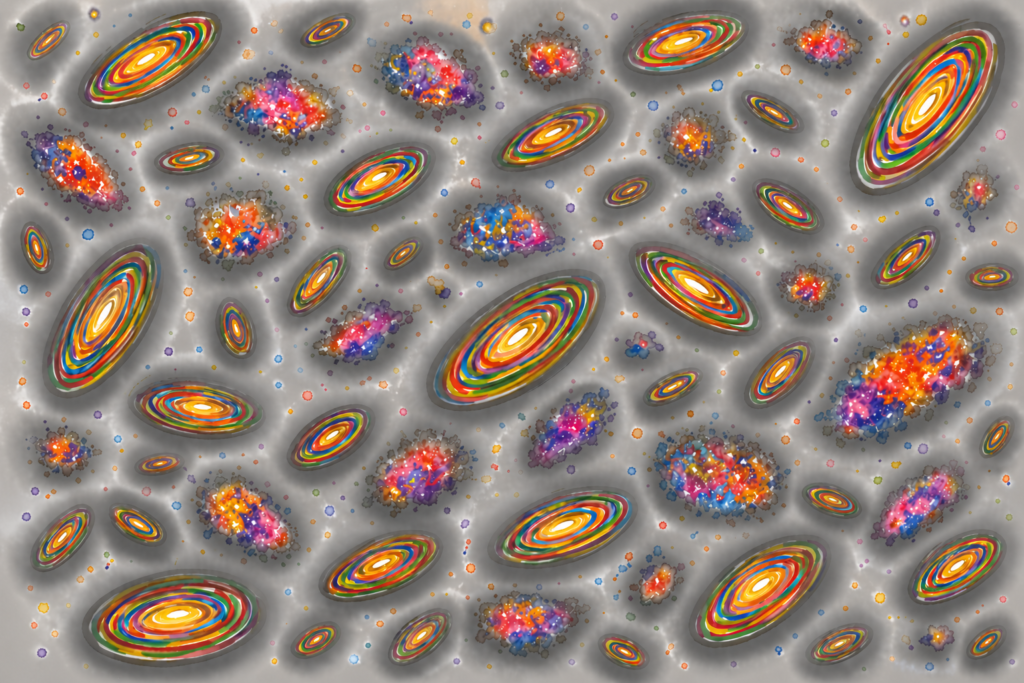
This is not specific to spiral galaxies — similar evidence suggests that dark matter accompanies almost every visible structure, and can even form its own substructure, sometimes with little visible matter.
Further and more precise evidence comes from the Cosmic Microwave Background — radiation arriving from all directions, carrying information about the early universe when it was much hotter and denser.
Together, these observations consistently point to the presence of additional, unseen matter.
What we know about dark matter is limited.
It behaves like a diffuse, collisionless component. It does not appear to interact with light, nor does it show clear signs of interacting with ordinary matter beyond gravity.
This strongly suggests that it is not made of the same particles as visible matter, but instead consists of some new type of substance.
One notable exception is the possibility of black holes contributing to dark matter.
At the same time, it is worth noting that our understanding of dark matter remains incomplete.
Given how little we know about its nature, it may seem surprising that scientists study detailed particle physics models of dark matter. The purpose of these models is not to speculate freely, but to embed dark matter as a concrete and well-defined extension of the framework that successfully describes visible matter.
In particular, such models aim to explain how dark matter could have been produced in the early universe with the right abundance.
At the same time, it is important to remain cautious.
The method of inferring unseen objects from gravitational effects has worked before — but it has also failed.
Shortly after the discovery of Neptune, Le Verrier applied the same reasoning to anomalies in the orbit of Mercury, proposing another unseen planet, which he named Vulcan. This planet was never found.
The discrepancy was eventually explained not by additional matter, but by a refinement of the theory of gravity itself, through Einstein’s general relativity.
One might then ask whether the need for dark matter could be avoided by modifying the laws of gravity instead.
This idea has been explored extensively. However, unlike the transition from Newton’s law to general relativity, no modification has been found that consistently explains the full range of observations while remaining compatible with the broader theoretical framework.
In particular, attempts to modify gravity within the framework of quantum field theory tend to introduce additional complications. No self-consistent alternative has emerged that can replace dark matter.
Therefore, unlike Vulcan, dark matter appears to be here to stay.
See also:
What is the visible universe made of?
How did structure form in the universe?