In the previous post, we argued that natural phenomena need to be understood within a language, and that meaning only exists inside a well-defined framework. This is what happens when we ignore that fact.
You have probably seen the phrase:
“Scientists theorize that…”
It sounds exciting, but it’s often deeply misleading.
In physics, a theory is not just an idea, nor merely a plausibility. It is a tightly constrained framework that must obey strict internal rules. Most things that get marketed as “theories” do not meet that standard.
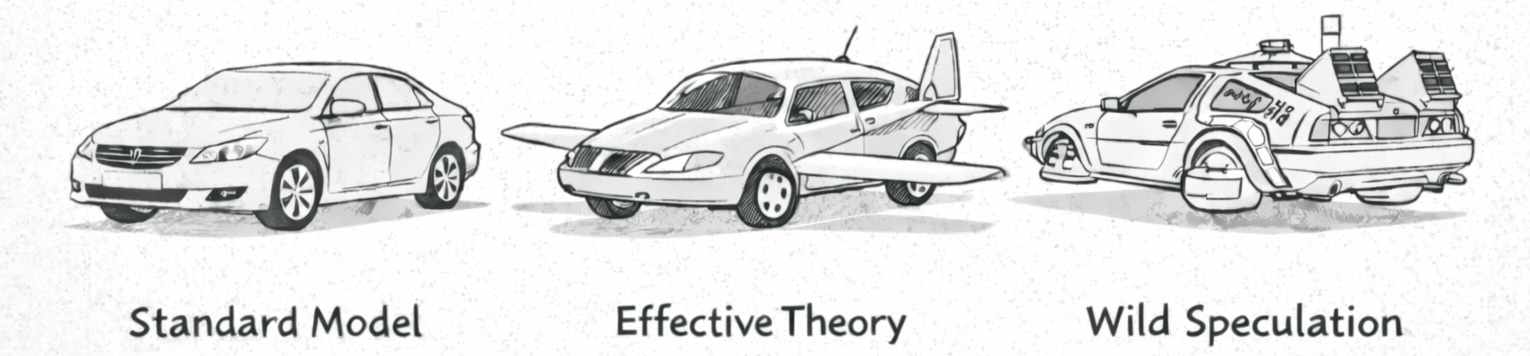
A useful way to see the difference is to think in terms of cars.
The standard car
The Standard Model of particle physics is like a well-engineered car. We know how to build it from fundamental components. We understand how its parts fit together. It runs reliably, within clearly defined limits.
It’s not perfect — but it works.
This is what a mature theory looks like.
The flying car
Now imagine a car that can open its wings and fly — not magic, but an ambitious engineering project. It’s hard to build, but working prototypes exist.
That is like an effective field theory.
Some of these theories are well-tested prototypes. Others are closer to conceptual designs. When it comes to describing our universe, the Standard Model is simply the most well-understood example in this class.
What separates these theories from speculation is that they remain constrained by the underlying framework.
A flying car does not defy the laws of nature as we know them. It extends familiar principles into new regimes, while remaining consistent with them.
We are not used to seeing it — but it combines concepts from vehicles we already know how to build.
The time-traveling car
And then there is the time-traveling car — like the one from Back to the Future.
If you accept all its properties as given, you can construct an entertaining story. But the moment you ask how it fits with everything else we know about the laws of nature, the story falls apart.
This is what many “theories” actually are — nothing more than wild speculations.
They’re not extensions of an existing framework. They don’t obey the grammar of the language they borrow words from. They aren’t constrained by consistency — only by imagination.
The mistake we keep making
In physics, you do not get to invent a new vehicle by ignoring the rules that make existing ones work. Consistency is not optional.
A real theory has to run.
A speculative idea only has to sound good.
Remember, not everything with wheels is road-legal.
And not everything called a “theory” belongs in physics.