Wormholes are mentioned abundantly in popular culture, to the extent that they have acquired an undeserved status as established objects of modern physics. They are routinely presented as tunnels connecting distant regions of the universe, different universes, or even different times. The actual physics provides considerably less reason to believe that such objects exist.
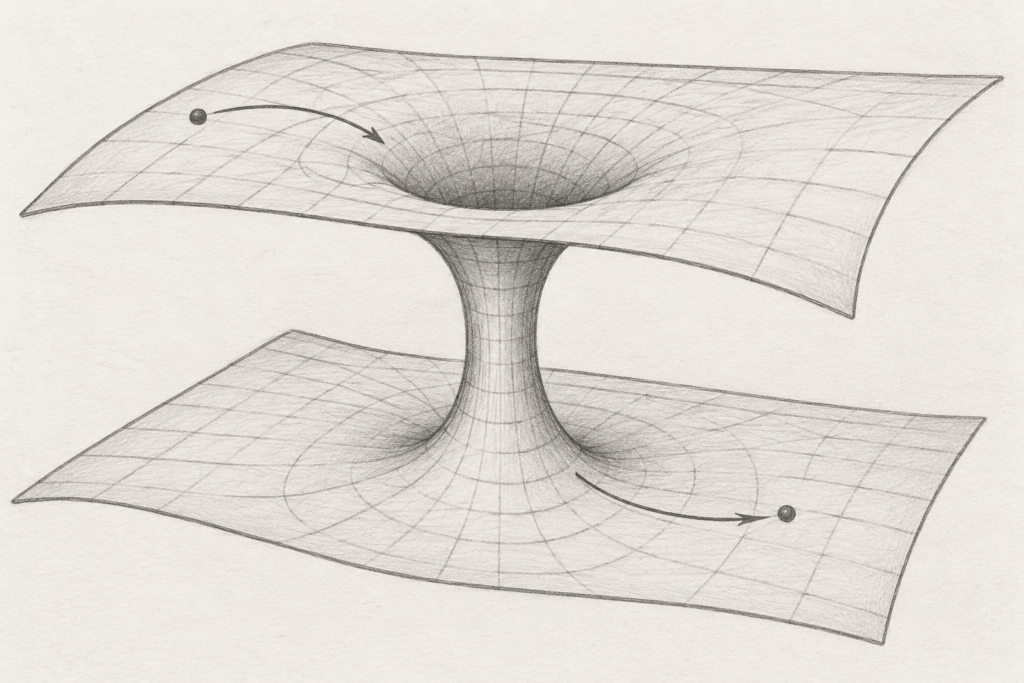
The historical starting point is the Einstein–Rosen bridge, which arises from an idealized eternal black hole solution. When the complete solution is considered, it contains two exterior regions joined through a bridge. This bridge, however, cannot be crossed: there is no trajectory by which an observer entering from one exterior can pass through and emerge into the other. It therefore does not describe the tunnel through space usually imagined when speaking about wormholes.
More generally, the existence of a mathematical configuration in General Relativity does not by itself establish the existence of a corresponding physical object. This becomes particularly clear if we look at Einstein’s equation,
Roughly speaking, the left-hand side describes the gravitational field, while the right-hand side describes the distribution and flow of energy and momentum responsible for it. The usual physical problem is to specify some matter and energy and determine the gravitational field they produce. Mathematically, however, we can reverse the procedure: invent a geometry with whatever unusual properties we desire, substitute it into the left-hand side, and calculate what would be required on the right.
With enough freedom in choosing the source, a vast variety of exotic geometries can be made to satisfy Einstein’s equation. The important question is therefore not simply whether a wormhole geometry can be written down, but whether the required source corresponds to something that can actually exist in a consistent theory of nature.
Black holes provide a useful comparison. Their classical solutions contain singularities, where physical quantities eventually become infinite and Einstein’s theory breaks down. If such singular solutions were all we knew about black holes, without any understanding of how they could form, there would be good reason to question whether they correspond to objects that can actually exist.
Instead, we can begin with an ordinary, nonsingular distribution of matter and follow its gravitational collapse. An event horizon forms while the evolution is still well described by General Relativity, after which the matter continues to collapse inside it. Only later does the evolution reach the singular regime where the classical description ceases to be trustworthy. Whatever replaces the singularity requires physics beyond Einstein’s theory, but this uncertainty does not invalidate the black hole that has already formed. The existence of astrophysical black holes is, of course, also independently supported by observation.
Wormholes have no comparable origin story. One can instead begin by specifying the geometry of a traversable wormhole and use Einstein’s equation to determine what form of energy and momentum would be necessary to keep its throat open. The answer requires a violation of what is known as the null energy condition, a condition satisfied by familiar forms of matter.
This requirement is commonly summarized by saying that wormholes need exotic matter. The terminology can make the problem sound deceptively simple, as though we merely need to discover some unusual substance and place it inside the wormhole. In reality, the problem has simply been transferred from the left-hand side of Einstein’s equation to the right. One still has to demonstrate that the required form of energy and momentum can arise from a consistent physical theory.
Some of the simplest attempts to produce the necessary behavior involve fields referred to as ghosts or phantoms. As the names suggest, these are not merely unfamiliar particles with unusual properties. Their presence generally brings severe consistency problems with it. In the simplest cases, the theory no longer possesses a stable lowest-energy state, allowing the system to decay by continually producing ordinary particles together with ghost excitations. The ingredient introduced to stabilize the wormhole therefore threatens the stability of the entire universe rather than merely the wormhole itself.
Quantum physics does permit more subtle violations of classical energy conditions without necessarily introducing such pathologies. This does not mean, however, that an arbitrary amount of the required energy can be produced and maintained. Relying on quantum effects to produce the desired effect would come with the entourage of enormous quantum uncertainty.
Attempting to make the violation of the null energy condition sufficiently large and persistent to support a macroscopic traversable wormhole generally encounters serious consistency problems or takes the description into a regime where it can no longer be trusted.
For this reason, even the familiar language of traversable and non-traversable wormholes can obscure the underlying issue. Calling the Einstein–Rosen bridge a non-traversable wormhole may suggest that General Relativity naturally produces the desired object and that traversability is merely an additional technical problem. The Einstein–Rosen bridge cannot be used as a passage between its two exterior regions, while geometries deliberately constructed to be traversable require additional sources that violate physical consistency.
We already know that in sufficiently extreme regimes, most obviously at singularities, something beyond the classical description must eventually take over. We cannot say with certainty what happens there, but the breakdown of our present understanding cannot itself be used as evidence for any particular possibility. A regime we do not understand is not evidence for a wormhole, a passage to another universe, or anything else we might choose to imagine.
With our present understanding, there is no observational evidence that wormholes exist, no established mechanism by which they could form from ordinary nonsingular matter, and no known healthy source capable of supporting a macroscopic wormhole within a regime where the theory remains under control.
Therefore, wormholes remain a speculative figment of the imagination.
See also: What is a black hole?