The universe is made of particles, and its evolution is dictated by the interactions among them.
To describe these particles, one must first specify the theory that encodes their identity. This means specifying their masses and the interactions they can undergo. Taken at face value, this may seem to tell us only how the particles behave in a few simple situations. But if the theory is formulated in a well-defined way within the language spoken by the universe, much more follows. Once certain basic processes are allowed, other more complicated ones can be inferred from them.
A useful analogy is that of a material sample. Suppose we are told its composition and dimensions. At first sight, this may seem to specify only a few basic properties. But once the material is known, one can already infer much more — for example, how it will respond to heat, pressure, or deformation.
The same is true for particles.
The visible universe is made predominantly of hydrogen, with helium making up most of the rest. A hydrogen atom is a bound system made of an electron and a proton, the latter being about two thousand times heavier than the electron.
At sufficiently high temperatures, such bound systems cannot survive. Hydrogen becomes ionized, and matter exists instead as a plasma of free electrons and protons, immersed in photons — the particles of light. In this form, the relevant processes are no longer those of atomic structure, but the interactions among these constituents.
This is where the logic of particle interactions becomes easier to see.
An electron (e) can emit some of its energy in the form of a photon (γ). A proton (p) can do the same. Written schematically, these processes take the form
e → e + γ,
p → p + γ.
These are two separate processes, but they can become intertwined.
The photon part of the interaction is the same in both cases. A photon emitted by one particle can be absorbed by the other, which immediately gives rise to a new process:
e + p → e + p
In other words, once electrons and protons are both allowed to radiate photons, they are also allowed to scatter by exchanging one.
The same logic applies more broadly. Electrons can scatter off electrons. Protons can scatter off protons. And if sufficient energy is available, other channels may open as well. One allowed interaction does not remain isolated. It generates a larger family of related processes.
One particle can therefore affect another through a messenger — rather like being affected by what friends of friends you have never met are doing.
The same collision need not lead to one unique observed outcome. Quantum mechanically, it evolves into a final state that can contain several allowed particle configurations, each contributing with its own probability. It is therefore not enough to ask whether a certain outcome is possible. One must also ask how likely it is relative to the alternatives.
But even this is not the end of the story.
Even after one has fixed a particular outcome, there are in general several different intermediate processes that contribute to it. A consistent description requires all relevant contributions to the same outcome to be taken into account together.

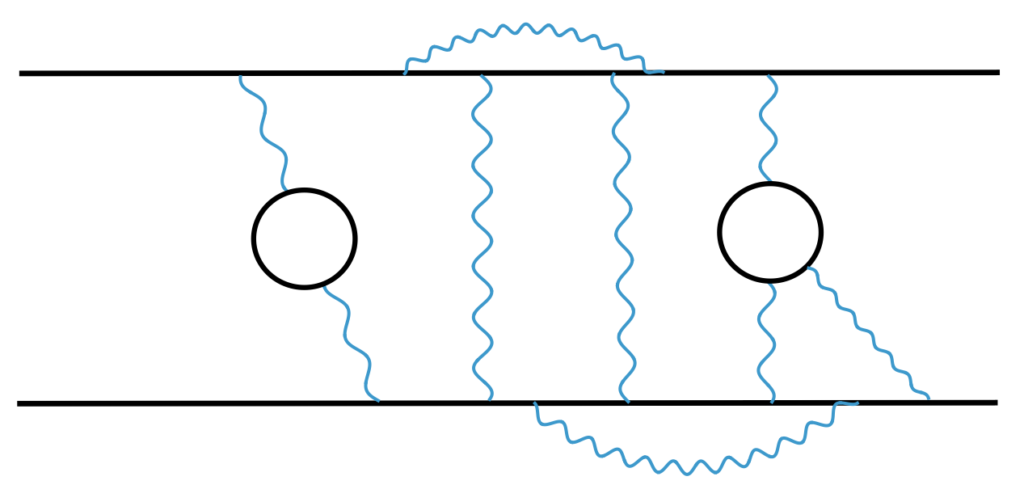
For the basic interactions that belong to our standard understanding of the universe, this is usually well understood and properly accounted for. In more exotic scenarios, however, these checks are sometimes neglected, and conclusions are drawn that do not actually follow from the theory.
Different types of particles interact with different strengths.
Some interact readily, exchanging energy efficiently and forming bound structures. Others interact only weakly, passing through matter with little effect. These differences determine how particles behave in a given environment.
All of the complexity we observe — from the formation of atoms to the behavior of matter — arises from these simple rules.
Everything else is built on top of them.
See also:
What is a language of the universe?
What is a theory in physics?