So far, we have discussed how the universe expands and how structure emerges from small perturbations. Let us now turn to a more basic question:
When we look at the universe, what do we actually see?
On large scales, the universe consists of galaxies and the space between them.
This space is not empty. It is mostly filled with a diffuse gas — the intergalactic medium — composed almost entirely of hydrogen and helium.
Alongside matter, there is also radiation: light in all its forms, traveling across the universe and carrying information about its past.
Looking inside galaxies, we find a more complex environment.
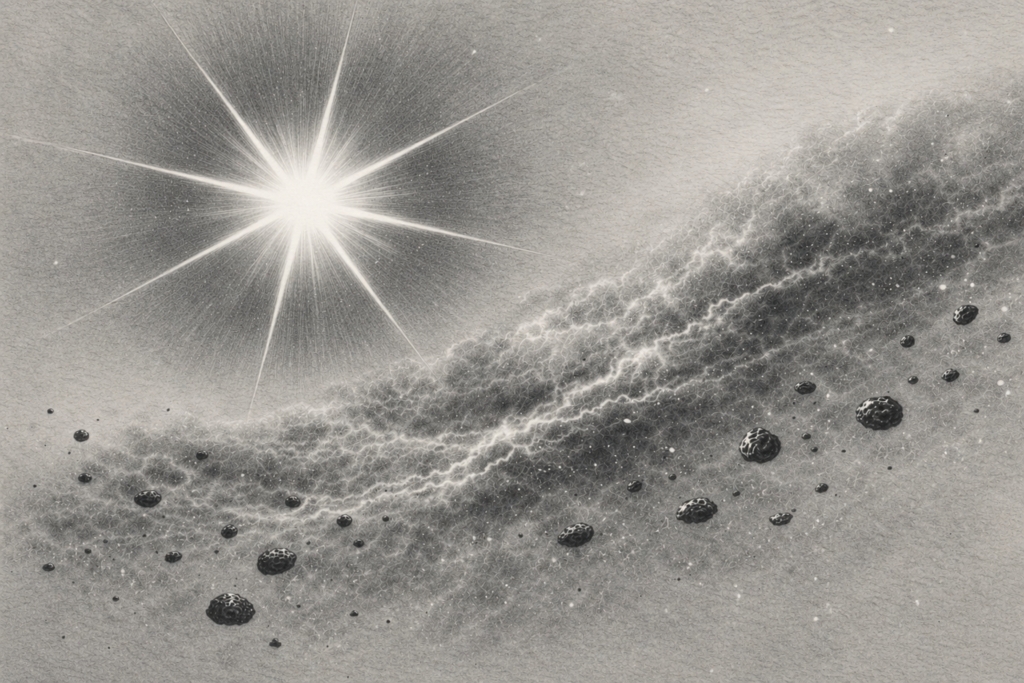
Galaxies contain stars and additional gas. The gas is still dominated by hydrogen and helium, but it also contains heavier elements — the stardust produced in stars.
Stars are not just luminous objects. They are factories.
Inside stars, lighter elements are fused into heavier ones. When massive stars reach the end of their lives, they explode, releasing these newly formed elements back into space.
Over time, this material becomes part of new generations of stars and planetary systems.
All the elements essential for life — carbon, oxygen, iron, and others — were produced in this way.
They are not primordial. They are the result of stellar evolution.
In this sense, the visible universe is built from a simple beginning.
It starts with hydrogen and helium, and through the life cycles of stars, evolves into a chemically rich and structured environment.
This, however, is only part of the story.
Next: Dark Matter